
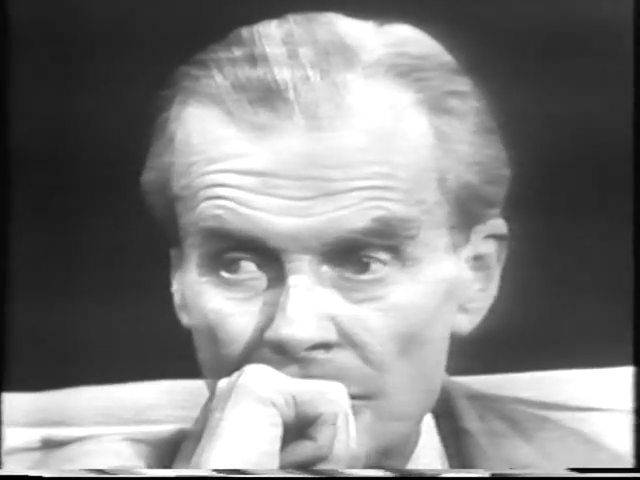
Excerpts from an interview with Aldous Huxley:
"...the two essential and important and indispensable things are, first of all, intelligence in the widest possible sense of that word, and goodwill, or in the old-fashioned word, charity, love...
...intelligence and knowledge without goodwill and charity are apt to be inhuman, and goodwill and charity undirected by intelligence and knowledge are apt to be either impotent or misguided...
...what is conventionally called intelligence...used to be called discursive thought, which is logical thinking in terms of our current scientific and philosophical frame of reference, but it also includes, so far as I'm concerned, intelligence in the sense of general awareness, of an awareness, so to say, on the non-verbal and non-conceptual level, and we have to have both.
I think it's very important to insist from the beginning that we are multiple amphibians living in many diverse and even, in some sense, incommensurable universes at the same time, and that our business in life is somehow to make the best not only of both worlds, because there are more than two of all the worlds we live in, and among the worlds we have to make the best of are, first of all, this world of discursive thought, the scientific and philosophical and practical world, and, at the same time, the world of non-verbal, immediate experience.
These are the two kinds of worlds in the worlds of intelligence which we have to make the best of."
- Aldous Huxley - from an interview: 'Sum and Substance' in 1958 (listen below)
Glossary:
"amphibians
origin: mid 17th century (in the sense ‘having two modes of existence or of doubtful nature’): from modern Latin amphibium ‘an amphibian’, from Greek amphibion (noun use of amphibios ‘living both in water and on land’, from amphi ‘both’ + bios ‘life’)."
"discourse
noun:
written or spoken communication or debate
...the language of political discourse
...an imagined discourse between two people.
...a formal discussion of a topic in speech or writing: a discourse on critical theory.
...[Linguistics] a connected series of utterances; a text or conversation.
...verb: speak or write authoritatively about a topic: she could discourse at great length on the history of Europe
...engage in conversation: he spent an hour discoursing with his supporters.
origin: late Middle English (denoting the process of reasoning): from Old French discours, from Latin discursus ‘running to and fro’ (in medieval Latin ‘argument’), from the verb discurrere, from dis- ‘away’ + currere ‘to run’; the verb influenced by French discourir."
"discursive
...ii) relating to discourse or modes of discourse: the attempt to transform utterances from one discursive context to another.
iii) Philosophy (archaic) proceeding by argument or reasoning rather than by intuition."
"incommensurable
adjective:
i) not able to be judged by the same standards; having no common standard of measurement: the two types of science are incommensurable and thus cannot be integrated.
ii) Mathematics (of numbers) in a ratio that cannot be expressed as a ratio of integers. • irrational."
If you'd like to contact me please visit this page.
Read more about my background and the services and tuition I offer here.
Click here to return to the home page.